
Satellite Images as Digital Evidence
Kym Hughes
30 Jan 2026
Recent years have seen significant advancements in satellite technology, resulting in satellite imagery becoming more accessible than ever before.
Historically, publicly accessible satellite imagery has been dominated by platforms such as Google and Bing. While they have transformed public awareness of satellite imagery, their reliability as digital evidence is limited.
These rely on infrequent updates to keep costs down, often resulting in years between two different images of the same location.
It’s even worse away from land. A matter of meters away from coastlines, detailed imagery is often non-existent and instead replaced by a uniform blue ocean colour.
This compromise is understandable as the demand for detailed imagery over vast expanses of water just doesn’t exist for these platforms. The end result is that using sources of imagery such as this is useful in a general context, but they are rarely suitable as a source of digital evidence.
Satellite Imagery as Digital Evidence
In contrast to the general platforms, modern satellite constellations provide higher availability imagery, often with precise timestamps and georeferencing metadata embedded alongside the images.
This leap means that satellite imagery is now a legitimate source of digital evidence, particularly when handled correctly and combined with other datasets such as AIS data or a VDR Reconstruction.
Used in isolation, a satellite image of an empty patch of ocean does not appear to provide relevant information, but when overlaid with an AIS track of a vessel, suddenly a different picture emerges.
Together, the two data sources tell a different story. The evidence suggests one of the sources of data may be incorrect.
However, the usefulness of satellite imagery as digital evidence can vary considerably.
Satellite Image Resolution
The primary consideration with using satellite imagery for digital evidence is its resolution.
Resolution is usually measured in meters, and tells you how clear the image is likely to be.
Low Resolution Imagery (≈10 meters)
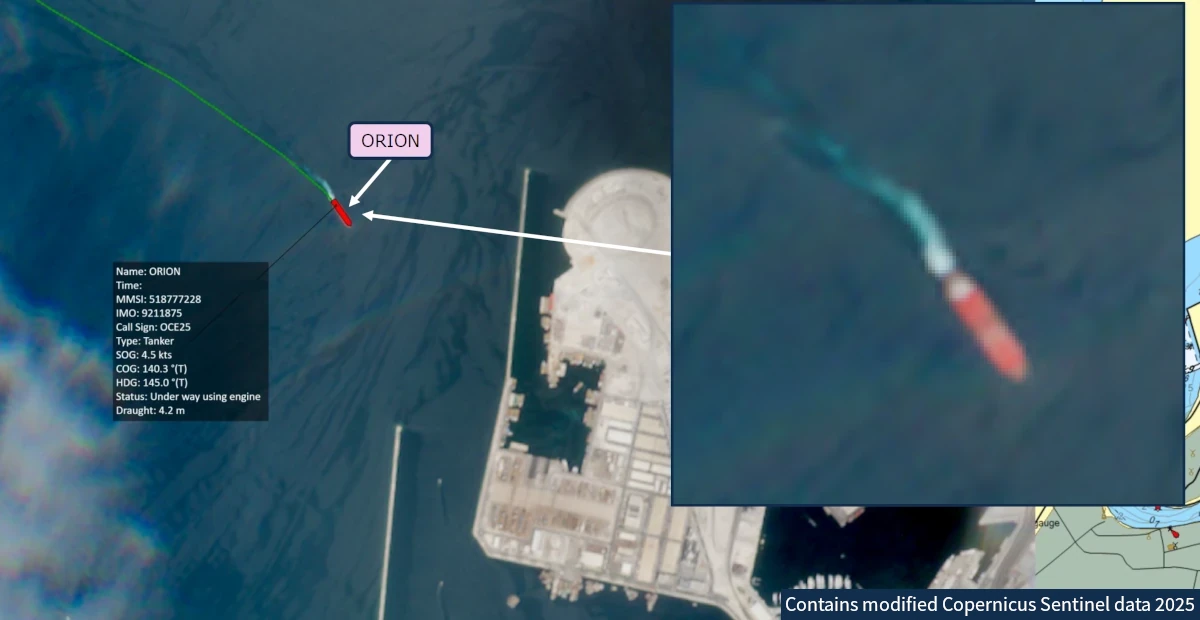
Typically around 10m per pixel, low resolution imagery is often the most accessible and cost effective option.
This class of imagery is widely available, and an appropriate source of digital evidence if you need to search a wide area.
At this resolution, it is easy to see large vessels, and sometimes even identify the general layout. For example, it might show you whether the accommodation block is nearer the bow or the stern.
At 10m resolution, you can gain an estimation of the vessel’s size, however, the accuracy of your measurement is directly related to the image resolution.
With the inherent errors in measurements, and the lack of resolution for identifying unique vessel characteristics, it is not possible to definitively identify a specific vessel using low resolution imagery.
Nevertheless, low resolution imagery is still appropriate when combined with other sources of data such as AIS, or for use in identifying the general distribution of vessels or infrastructure in a particular area.
Medium Resolution Imagery (≈3 meters)
At around 3m per pixel, medium resolution imagery offers greater detail than low resolution options, but comes with the disadvantage of higher costs and more difficult sourcing.
Nevertheless, medium resolution imagery is relevant for most commercial applications, resulting in high availability, often with daily coverage of most areas.
The disadvantage is that for medium resolution satellite imagery to be cost effective, it is essential to target a small geographical area. This makes it highly relevant for verification of data already provided by low resolution imagery.
At 3m resolution, you can identify more features on vessels, such as the position of lifeboats, the colour of the deck, and the number of cargo hatches. However, definitive identification of vessels is still not possible, unless it is combined with another source of data.
High Resolution Imagery (<0.5 meters)
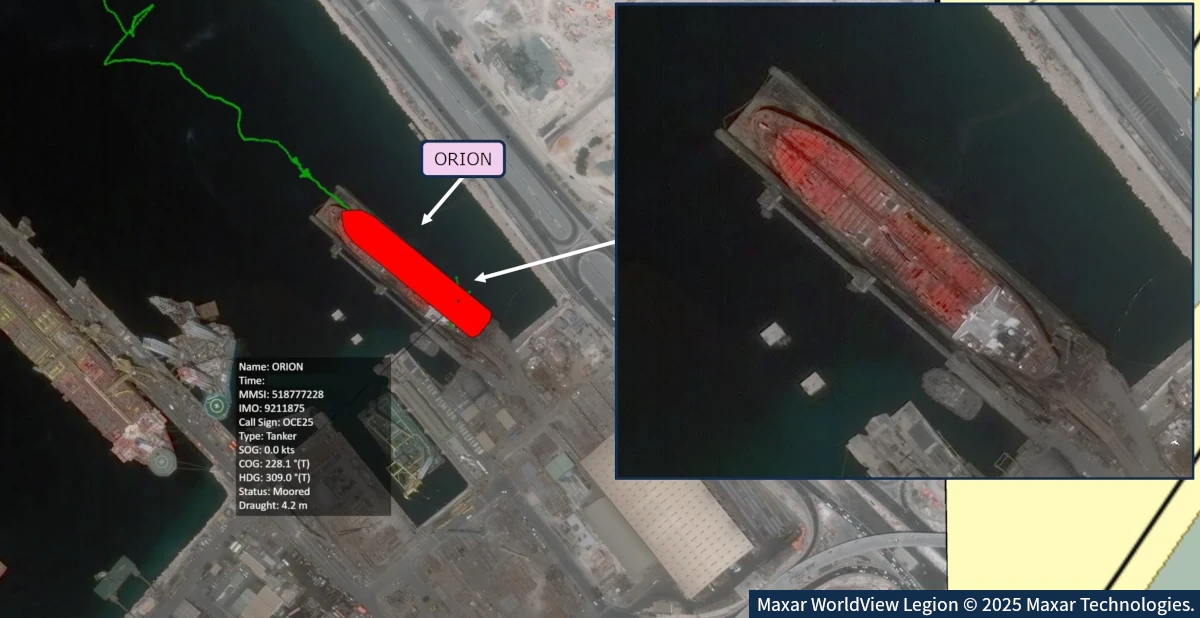
With a resolution often less than 0.5m, high resolution imagery offers the greatest level of detail.
It is sometimes possible to definitively identify vessels and infrastructure, such as the positions of bollards along a quayside, or the position of a wreck in shallow water.
This level of detail comes at a cost, however, with high resolution images being significantly more expensive than both medium and low resolution images.
For this reason, using high resolution satellite imagery as digital evidence is most appropriate when a specific, restricted geographical area has been identified.
Use of Satellite Imagery as Digital Evidence
As satellite imaging technology continues to improve, its use as a form of digital evidence is only set to increase.
Used in isolation, satellite images can offer insights that are not available through other means, however, the greatest value is unlocked when satellite images are combined with other data sources and presented together in a visual way.
Handled correctly, satellite imagery can turn a data heavy analysis into something highly visual, effective adding photographic proof to either prove or disprove the validity of an entire dataset.